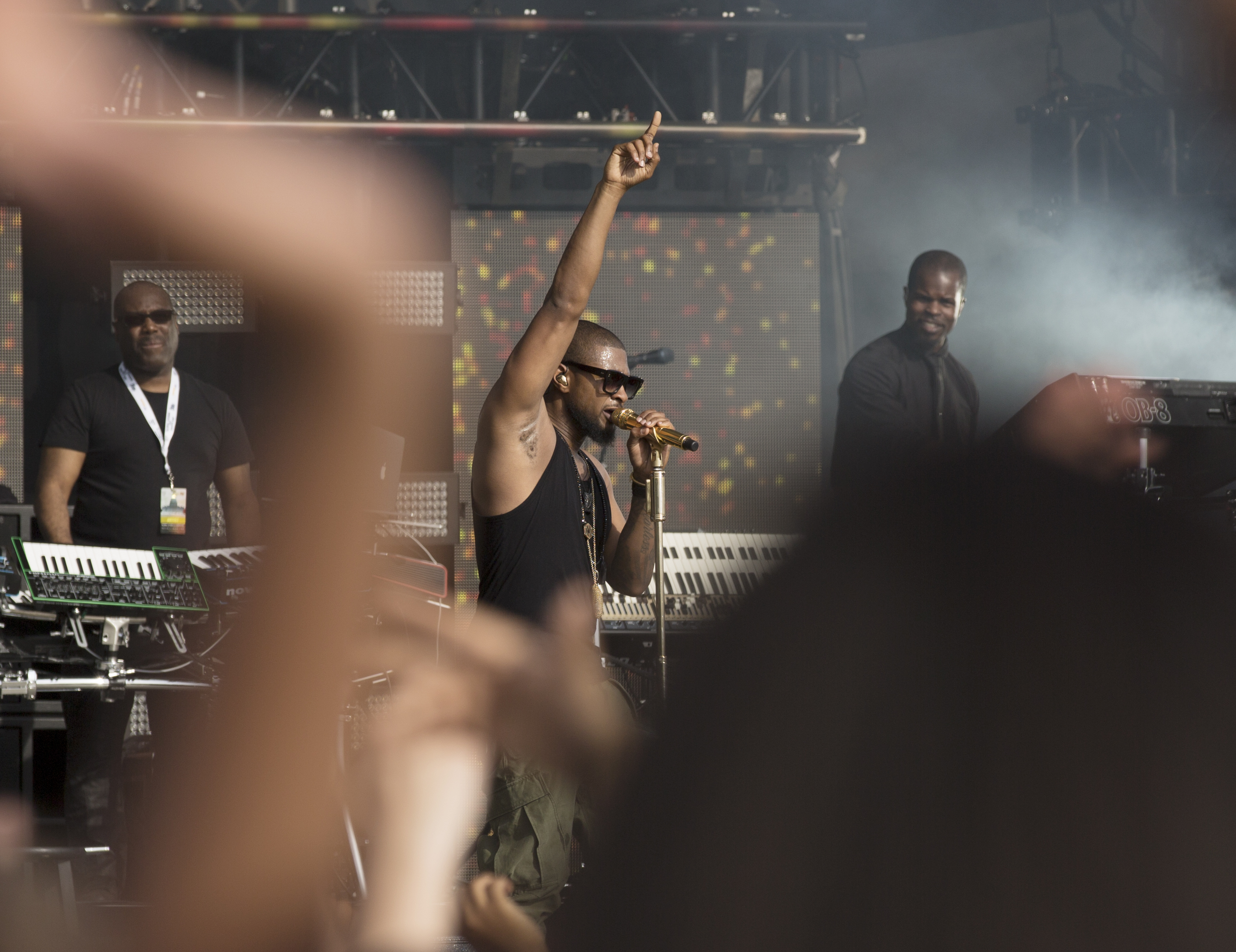
File photo: Usher performing at the Global Citizen Earth Day concert in Washington, D.C., on April 18, 2015. This is not a photo of the New Orleans show.
A fire performer fell off the stage while twirling flaming batons at Usher and Chris Brown's R&B Tour stop in New Orleans on Nov. 21. His condition is still not known.
A fire performer fell off the stage while twirling flaming batons at Usher and Chris Brown's concert in New Orleans on Saturday night, in a frightening moment captured on fan video that has now been seen around the world — and which has raised new questions about safety on a tour that was already under strain.
The incident happened during the second of the pair's two nights at the Caesars Superdome, on the R&B Tour — the joint stadium run named for the singers' surnames, Raymond and Brown. In fan-captured video first reported by TMZ, a performer twirling two batons lit on both ends can be seen stepping backward off a ledge on the stage and falling down a flight of stairs. For a few seconds he appears to be surrounded by flames and smoke. Onlookers can be heard shouting as he tumbles backward. He then hops back up and, seemingly unhurt, continues the performance.
The performer was identified by the Daily Mail as Deshawnte "Smoothgalaxy" Williams. What happened next is less clear. The video cuts to a person being strapped to a stretcher and carried out of the venue — although it is not clear whether that person is the fire performer. As of Sunday, November 22, Williams' condition was not known, and representatives for Brown, Usher and Live Nation, which produces and manages the R&B Tour, did not immediately respond to PEOPLE's request for comment.
It is unclear exactly when during the artists' sets the performer fell. The show went on. The second New Orleans night also featured a surprise performance from the city's own Master P, and the first night had featured a surprise appearance from Lil Wayne. Fans in the Superdome sang along to hits like "Yeah!" and "Under the Influence" across the two nights, and the tour — which first launched in June in Denver and continues with North American stadium dates through December — rolled on to its next stop with the incident unresolved.
A tour already under strain
The fall did not happen in a vacuum. The R&B Tour has been one of the year's most scrutinized live runs, and not only for its spectacle. On November 12, a source told PEOPLE that Usher, 48, and Brown, 37, were still managing the fallout from a massive backstage blowup earlier in the tour. Simmering tensions allegedly reached a breaking point in Atlanta on November 5, when a show at Mercedes-Benz Stadium started two hours late. The first New Orleans stop, meanwhile, left some fans facing difficulties of its own, according to a report by WGNO, the local ABC affiliate — a detail that, combined with Saturday's fall, has left the tour's New Orleans weekend looking like a run of trouble rather than a triumph.
The show's production is built on spectacle. The pair tour with an elaborate troupe of backing talent, from singers and dancers to fire artists, and the fire act is part of the staging that has defined the run — along with flying rigs, guest appearances and the sheer scale of a two-headliner stadium show. The video of Saturday's fall shows why that spectacle carries risk: a performer working with open flame, on a raised stage, in the dark, in front of tens of thousands of people, with a ledge behind him. The fall was, by the video evidence, a matter of a single backward step.
The reaction online has split, as it usually does after a live-show accident. Many commenters expressed genuine concern and prayers for the performer. Others turned the moment into a joke, or into an argument that the tour — long, loud, heavy on pyrotechnics and flying stunts — has become a risk that is no longer worth taking. "Time to wrap it up," one thread of comments runs, a sentiment echoed across social media compilations of the footage that circulated through Monday. The footage itself, shot on phones from the crowd, is the only public record of what happened; neither the tour nor the venue has issued a statement as of this writing.
The safety question live music keeps facing
Saturday's fall is the latest in a run of onstage accidents that have forced the live industry to talk about safety in public. Stadium tours have grown bigger, louder and more acrobatic in the last decade, with pyrotechnics, fire effects, aerial rigs and moving stage pieces now standard even for artists whose music never needed them. The crews who build and operate those effects are specialists, and the performers who work inside them train for the danger — but the danger does not go away because it is choreographed. A fire performer who falls while holding lit batons is, for a few seconds, a person on fire in front of a crowd, and the difference between a scare and a tragedy on Saturday appears to have been luck and a quick recovery.
The industry's record on this is mixed. Tours have improved their safety protocols after high-profile incidents in recent years, with stricter rules around pyrotechnics, clearer sightlines for stage edges and better medical response on site. But the economics of the modern stadium tour push in the other direction: more dates, bigger productions, more spectacle to justify ticket prices that keep climbing. The R&B Tour's own schedule — a June launch, stadium dates running through December, two nights in a building the size of the Superdome — is the shape of that economy. The question Saturday's video asks, without answering, is whether the spectacle has outrun the margin for error.
There is also the question of what the audience is owed. Fans who filmed the fall posted it within hours, and the footage — first on TMZ, then across every social platform — became the story of the weekend before either headliner had said a word about it. In the absence of a statement from the tour, the fan video is the record, and the performer's condition remains a matter of public speculation rather than confirmed fact. That silence is itself part of the story: when a performer is hurt — or might be hurt — on a stage that big, the tour's first obligation is to say so, and to say what happens next.
What happens next
The tour continues, with North American stadium dates scheduled through December. Whether the fire act remains in the show, whether the staging changes, and whether Williams' condition is confirmed are all open questions as of Tuesday morning. Live Nation, Brown's team and Usher's team have not responded to requests for comment, and no statement has been issued about the incident. The next show will be watched closely — not for the setlist, but for what has changed on the stage.
Why this matters for Hollywood
Hollywood and live music are the same business now: the same audiences, the same ticket prices, the same expectation that a night out should feel like an event. The R&B Tour is a stadium-scale production in the same economy as a $200 million film opening — and it carries the same risk when spectacle is the product. A fire performer falling off a stage in New Orleans is, on its own, a scary moment at a concert. But it lands in a year when the live industry has been selling ever-bigger shows to ever-larger crowds, and it asks the question the industry least likes to answer: how much danger is the audience buying a ticket to watch?
For Los Angeles, where both headliners have deep roots and where the tour will be judged as much as anywhere, the incident is also a reminder of how much of the modern concert business is built on the people the audience never notices — the fire artists, the riggers, the dancers and the crew who make the spectacle work. The show went on after the fall. The performer got up and kept going. Whether that is a testament to professionalism or a sign of a production that asks too much of the people on its stage is the argument the video has started, and it is not going away.