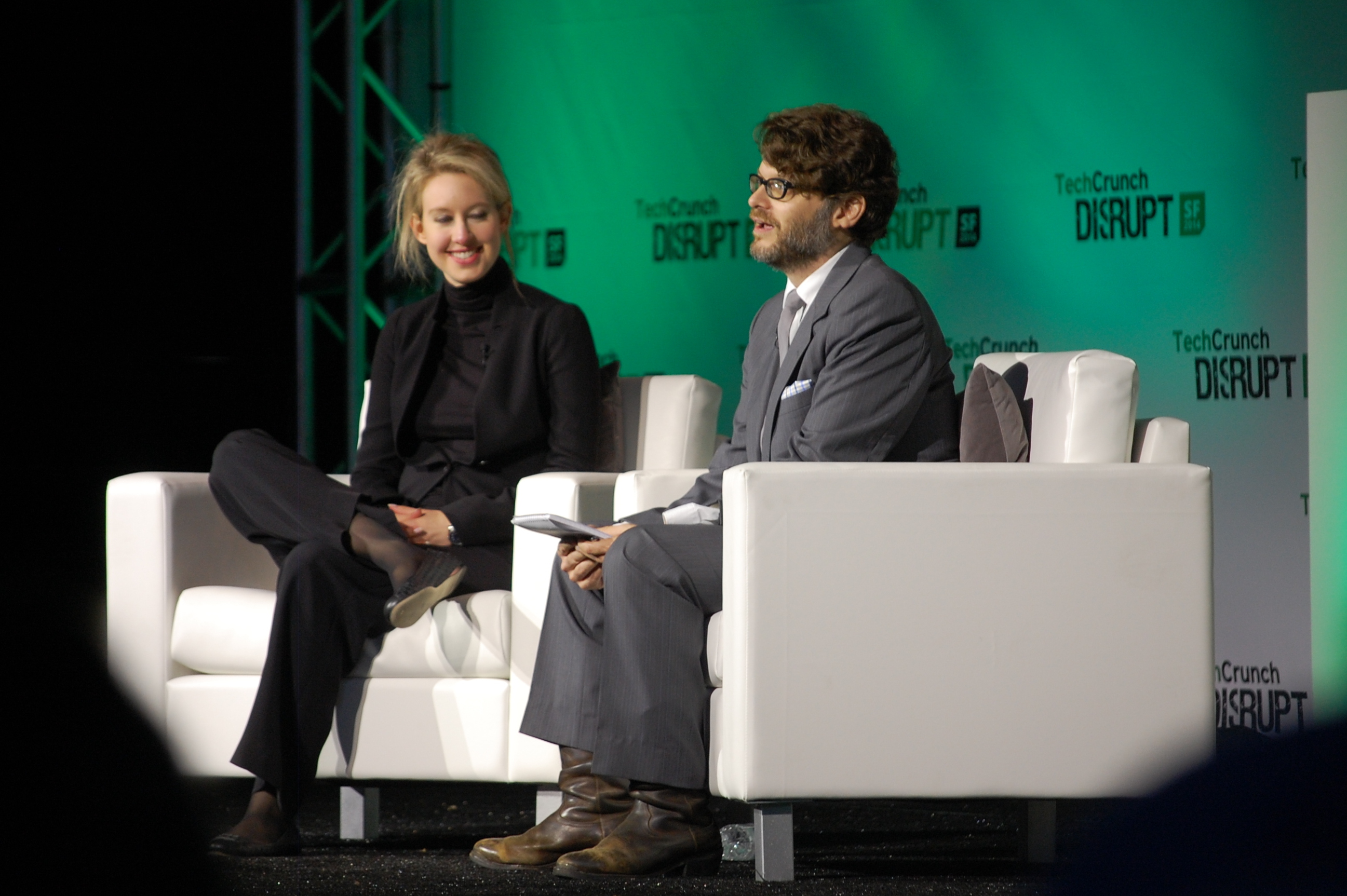
File photo: Elizabeth Holmes (left) at TechCrunch Disrupt in San Francisco on September 8, 2014. This is not a still from the documentary 'You Can See Everything.'
A24's secret Elizabeth Holmes documentary You Can See Everything has passed $102.4 million worldwide on a reported $7 million budget — a feat almost no documentary ever reaches.
A three-hour documentary about a disgraced Silicon Valley founder, made in secret for a reported $7 million, has now earned more than $100 million at the worldwide box office — a milestone almost no documentary in history has ever reached, and one that has turned a film about fraud into the most unlikely theatrical success story of the year.
You Can See Everything, the A24 documentary about Theranos founder Elizabeth Holmes directed by comedian Nathan Fielder and filmmaker Lance Oppenheim, crossed the mark over the weekend, reaching $102.4 million worldwide, according to Variety's weekend tallies published on Sunday, November 22. Almost all of it has come from American audiences: $93.4 million domestically, with roughly $9 million from overseas markets so far. The Los Angeles Times marked the milestone on Monday under the headline "'You Can See Everything' makes $100 million worldwide, a rarity for documentaries" — and rarity is the right word. Documentaries almost never do this.
The film, which runs 174 minutes and follows Holmes over three years in the lead-up to her prison sentence, with Holmes herself appearing on camera, has been breaking the genre's records since the day it opened. It premiered as an unannounced secret screening at the 53rd Telluride Film Festival on September 6, 2026, then opened wide in the United States on October 16 with $15.6 million from 855 theaters, plus $1.75 million in previews on October 15. That was the second-biggest domestic launch ever for a non-music documentary, behind only Michael Moore's Fahrenheit 9/11 in 2004, and the highest-grossing domestic opening weekend for a release in fewer than 1,000 theaters since Borat in 2006. It went on to become the first documentary ever to reach No. 1 at the domestic box office in its third weekend of release.
The records keep falling
The weekend that pushed the film past $100 million also set records abroad. It opened in the United Kingdom on November 20 with $3.2 million — £2,454,037 — from 596 locations, the largest opening weekend ever for a non-music documentary in Britain, and A24's second-biggest UK debut behind Backrooms and its $5.7 million. Australia and New Zealand together have contributed $3.8 million, and Turkey, Poland, the Czech Republic, Russia, the United Arab Emirates and Greece have added roughly $2 million between them. Public trackers like The Numbers had not yet caught up on the international side and showed only about $3.3 million overseas as of November 20, which means a significant share of the international business has not been posted yet.
More markets are still to come. The film opens in Mexico, Brazil and Argentina on November 25 and 26, with Sony Pictures handling distribution in some international territories, so the worldwide total could end up significantly higher than $102.4 million. It remains the second-highest-grossing domestic non-music documentary of all time, with only Fahrenheit 9/11 and its $119.1 million domestic total left to beat — a record that has stood for 22 years and is now, for the first time, genuinely in reach.
The audience response has been as remarkable as the grosses. Over the weekend, You Can See Everything became the first documentary film ever to be watched by one million members of Letterboxd, the film-lovers' social platform, where it is the highest-rated film of 2026 and the second-highest-rated documentary ever, trailing only Stop Making Sense. It holds a 97 percent rating on Rotten Tomatoes, based on 247 critic reviews. A nearly three-hour documentary about a convicted fraudster is, by the metrics of the platform where young cinephiles keep score, the best-liked film of the year.
How A24 did it
The business story is as striking as the artistic one. A24 produced the film in near-secrecy for a reported $7 million — a figure the studio has never confirmed — and turned it into a word-of-mouth event through a rollout that treated secrecy itself as marketing. There was no trailer campaign telegraphing the film months in advance, no festival bidding war played out in the trades. There was a surprise screening at Telluride, and then the film simply arrived, with audiences discovering it and telling each other about it.
That approach is now being studied as a marketing lesson in its own right. Inc. magazine's analysis of the run called it a guerrilla-marketing playbook: a lean budget, a surprise rollout and organic buzz, converting roughly $7 million into more than $100 million. The comparison that matters most inside A24 is the one to the studio's own history. The film's $15.6 million opening was a record for the company in its own way, and its sustained legs — six weekends in release, still selling out screenings in territories as far apart as Australia, the UK and Scandinavia — are the kind of run that studio executives dream about and almost never get from a documentary.
It also fits a pattern in A24's year. The studio's Backrooms, the other half of the horror story that has defined 2026 alongside Obsession, took $400 million worldwide, and its UK debut of $5.7 million remains the benchmark You Can See Everything chased in Britain. A24 is having a year in which its films keep setting records that, a decade ago, would have seemed impossible for an independent distributor.
The Holmes story, again — and why it still sells
There is an irony in the film's success that the film itself seems to understand. Elizabeth Holmes built Theranos on a story — a young founder, a world-changing device, a mission to democratize blood testing — and the story turned out to be a fraud that sent her to prison. You Can See Everything is, by its title alone, a film about watching: about what the camera sees, what a founder shows the world, and what audiences believe. That it has become a $100 million hit by inviting audiences to watch Holmes, up close, for three hours, in the period before her imprisonment, is a neat piece of symmetry — the fraudster as box-office draw, the story of a story as a story that sells.
The film's Oscar prospects are now part of the conversation, too. With a 97 percent Rotten Tomatoes score, a record-breaking gross and a Letterboxd following that no documentary has ever matched, You Can See Everything stands as a major awards contender as the season heats up — and the Academy's newly announced rules for the 99th Oscars, which require screenplays to be human-authored and performances to be demonstrably human, do nothing to stand in a documentary's way.
What happens next
The international rollout continues this week, with Mexico, Brazil and Argentina opening on November 25 and 26, and the film still playing in US theaters after six weekends. The question now is not whether it will make more money — it will — but how far it can go. Fahrenheit 9/11's $119.1 million domestic record is $25.7 million away, and with Latin America still to open and the film's word of mouth still building, the gap is closable. The worldwide total, meanwhile, will keep climbing as each new market reports.
Why this matters for Hollywood
Hollywood spent the year learning that audiences will turn out for event films — the Hunger Games' $120 million opening, Obsession's $525 million run, GTA VI's $4 billion weekend in games. You Can See Everything proves the same appetite extends to the least event-like film imaginable: a three-hour documentary about a convicted fraudster, made in secret, with no stars and no franchise. It did it without a $200 million budget, without a global day-and-date blitz, and without the marketing spend that studios usually consider the price of admission to a $100 million gross.
For the studios, the lesson is the same one Obsession taught, in a different register: the audience is there for films that give people something to talk about, and the talking is the marketing. A24 spent a reported $7 million making the film and let the film itself do the rest. For documentary filmmakers, who have spent decades being told their work could not make real theatrical money, the $102.4 million total is a door opening — and the fact that it is a film about a woman who sold the world a false story, told by a comedian and a documentarian who filmed her for three years, only makes the irony richer. The story sold. The film about the story sold, too.
More in Industry
Hollywood Is Losing the Fight to Keep Production in Los Angeles — And Now Washington Is Getting Involved
Skydance Is Merging Warner Bros. and Paramount TV Into One Studio — And Hollywood Is Bracing for What Comes Next