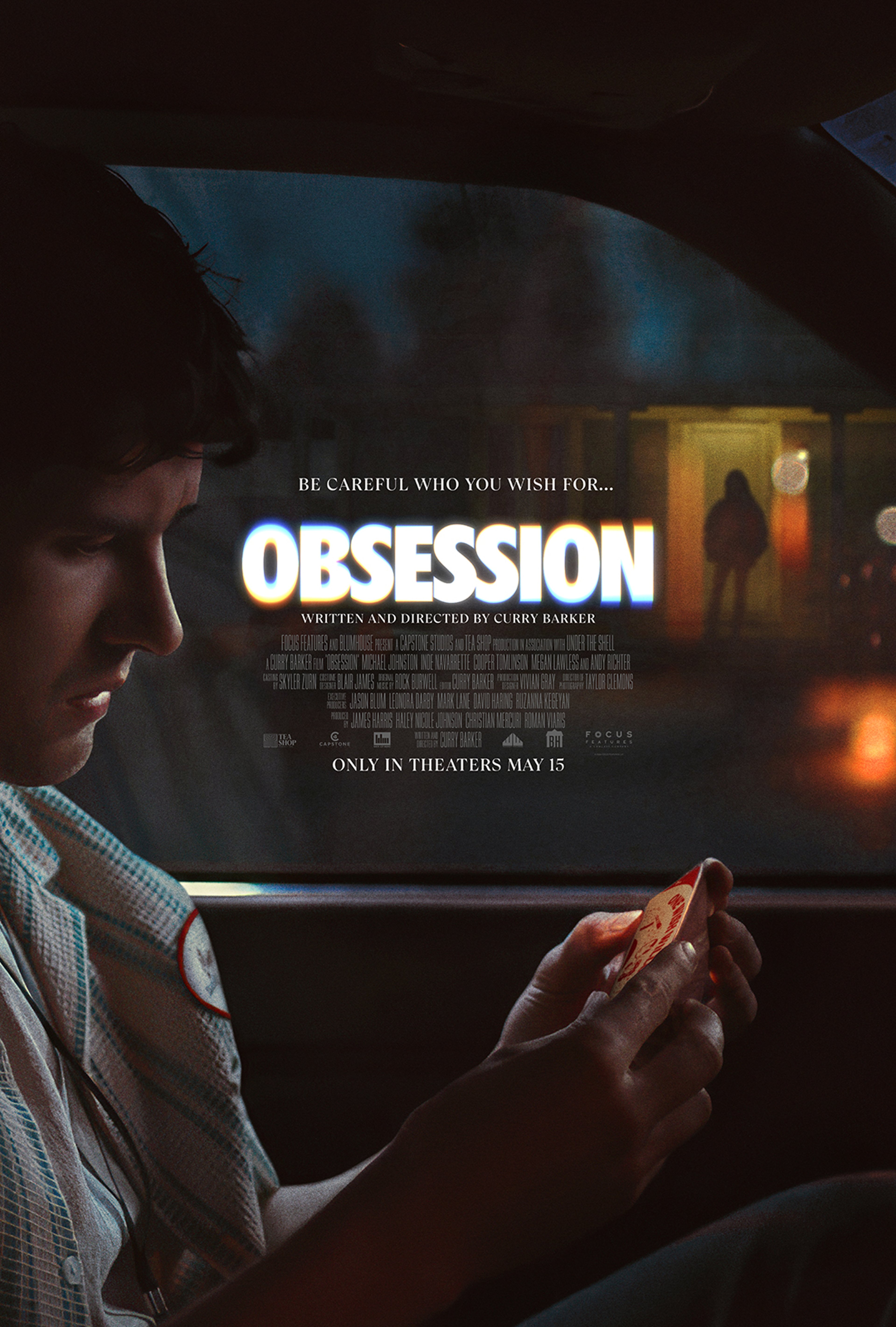
Curry Barker's $750,000 indie horror Obsession has grossed $525 million worldwide, becoming Focus Features' biggest film ever — and the director refused to change a frame of it.
A horror film made for $750,000 on the streets of Los Angeles has now grossed $525 million around the world, and on Tuesday the Los Angeles Times put its director and young stars on the cover of its Envelope special issue to ask the question Hollywood has been asking all year: how did a movie almost nobody would finance become one of the biggest hits of 2026?
Obsession, written, directed and edited by Curry Barker, is the story of a young man who breaks a wish-granting "One Wish Willow" to win over his crush — and discovers the wish works a little too well. It stars Inde Navarrette as Nikki and Michael Johnston as Bear, and it has become the tenth highest-grossing film of 2026 and the fifth highest-grossing horror film of all time, unadjusted for inflation. It is also, according to Deadline, now the top-grossing film in the history of Focus Features, the studio that bought it.
The numbers still look like a misprint. The film was shot in Los Angeles in October 2024 — in Burbank, the San Fernando Valley and North Hollywood — for $750,000. It premiered on September 5, 2025, at the Toronto International Film Festival's Midnight Madness section, where it started a 24-hour bidding war that ended with Focus Features acquiring the rights for around $15 million. It opened in theaters in the United States on May 15, 2026, and it has not stopped growing since. "When it made $27 million, I couldn't believe it," Barker told The Hollywood Reporter earlier in the run. "It became a word-of-mouth movie."
A year horror took over the box office
Obsession did not arrive alone. Horror has taken in a reported $2.49 billion at the worldwide box office so far in 2026, a figure presented at Blumhouse and Atomic Monster's The Business of Fear 2026 symposium and reported by Deadline. By those figures, more than a third of the entire year's horror gross came from just two films that were not sequels to anything: Obsession at $524.4 million and A24's Backrooms at $400 million. Together they grossed a combined $924.4 million — about 37 percent of the reported 2026 horror total.
The rest of the year's horror chart underlines how unusual that is. Sony's Insidious: Out of the Further took $172 million and Universal's The Other Mommy took $120 million — strong numbers for the genre, and still less than a quarter of what Barker's film earned.
The film's reach kept widening after theaters. Obsession arrived on Netflix in the United States on November 17, 2026, a week before the Los Angeles Times devoted its Envelope special issue to it — a cover story built around a group portrait of Navarrette, Johnston and Barker under the headline "The obsession over 'Obsession.'" In the piece, Navarrette describes the film as belonging to her generation, sparking conversations in theater parking lots and across social media, and recalls one audience member vomiting in a theater. Johnston says he received no auditions for a year after the film's Toronto debut. Barker explains why he refused to rewrite the script into a conventional Hollywood version — the decision that may have saved the film.
The Hollywood version Barker refused
That refusal is now the most-told story in the film's legend. Capstone Studios, the film's financier, offered to nearly triple the budget to $2 million if Barker would rewrite the script to make Bear the hero instead of the antagonist he becomes once he realizes Nikki never consented to their wish-fueled relationship. The studio also suggested Barker shoot a version in which Nikki survives. Barker said no to all of it.
"She's still possessed," Barker said of the ending he refused to change, in the Los Angeles Times piece. "Vomit. I'll never do that. I'll never compromise." It is the kind of line that would sound like marketing if the box office had not backed it up. The ending audiences argued about in parking lots — the one that reportedly made someone physically sick — is the ending that turned a $750,000 film into a $525 million one.
The gamble looks even more remarkable set against Barker's path to it. Before Obsession, he had built a following on the sketch-comedy YouTube channel "that's a bad idea," which he runs with Cooper Tomlinson — a platform he has described as "our film school outside of film school." His previous feature, the found-footage horror film Milk & Serial (2024), was made for about $800 and released on YouTube after a fruitless year seeking distribution. Two years later, he was turning down an extra $1.25 million to protect an ending.
What the stars say — and where they go next
The film has changed the working lives of its two leads as completely as its director's. Navarrette, the breakout star, has said she is "totally open" to making a sequel should Barker choose to devise one — and she has already moved on to franchise work, set to play Rogue in an X-Men reboot and starring in and producing the science-fiction thriller The Waffle House Index for Apple Original Films. Johnston is shooting a new Mummy film with Brendan Fraser in London and will soon ride a camel in Morocco for the production.
Barker, for his part, has a detailed outline for a sequel and has told the Associated Press, "A sequel isn't hard for this movie." But he does not want to make it next, and when he began describing the outline over lunch with the Times, Johnston shouted, "Redact! Redact! Redact!" What Barker has said publicly is that a follow-up would center on a new person with a new One Wish Willow, rather than a continuation of Nikki's story — and Navarrette's own answer to what happens to Nikki after the credits is deliberately unglamorous. "I think the non-pretty answer, which I think is more important to give sometimes than kind of giggling through answers, is she's starting a grief process," she said. In the Times piece she went further: Nikki faces potential double-homicide charges and goes on a journey to understand what happened, eventually writing "a phenomenal book about it." The "pretty answer," she said, remains unwritten.
Barker has also said there is a longer version of the film in existence — around 20 minutes of additional footage — and told Rolling Stone he would love to release it one day. But he was clear that the version in theaters should be considered the director's cut. "I think I'm pretty happy with the cut right now," he said. "There's not things I would change with the footage that I have. I did what I wanted for the most part."
Barker says the film has "more laughs" than some comedies, a wry acknowledgment of the category debate that follows any horror film with a breakout year. Parents, Navarrette told the Times, report their children seeing it five times.
What happens next
Barker's next film is already shot. Anything But Ghosts, which he wrote and directed with Cooper Tomlinson before Obsession reached theaters, follows fake investigators who pose as ghost hunters — and one day enter a real haunted house. It stars Aaron Paul, Bryce Dallas Howard and Violet McGraw alongside Barker and Tomlinson, with Matthew Lillard joining during additional photography in a role being kept under wraps. Focus Features has set its release for May 7, 2027. Barker is also signed to reboot The Texas Chainsaw Massacre, a franchise assignment that would have been unthinkable for a YouTube sketch comedian two years ago.
The bar for Anything But Ghosts, as one horror outlet put it, is sitting at roughly half a billion dollars. No pressure.
Why this matters for Hollywood
Obsession is the purest version of the story Hollywood tells itself about why the theatrical business still works: a film nobody could have predicted, made for almost nothing, found its audience one screening at a time and became a cultural event that no algorithm ordered into existence. It was not a sequel, not a remake, not a franchise installment and not a star vehicle. It was a first-time theatrical director, two young actors and a $750,000 budget — and it outgrossed nearly every studio tentpole of the year.
For the studios, the lesson is uncomfortable and specific. The money was available to triple the budget and sand down the ending, and the film made $525 million precisely because its director refused. For Focus Features, the film is now the biggest grosser in the company's history, bought for $15 million out of a festival bidding war that lasted a day. For the independent filmmakers watching from Los Angeles, where the film was shot, the message is simpler: the distance between a $800 YouTube feature and a $525 million theatrical hit turned out to be one uncompromised idea, protected at exactly the moment it would have been easiest to give it up.
More in Industry
Hollywood Is Losing the Fight to Keep Production in Los Angeles — And Now Washington Is Getting Involved
Skydance Is Merging Warner Bros. and Paramount TV Into One Studio — And Hollywood Is Bracing for What Comes Next